

Fashion Law Fascination at the Helsinki IP Summit – from critical notes on the sector’s sustainable development to recent case law
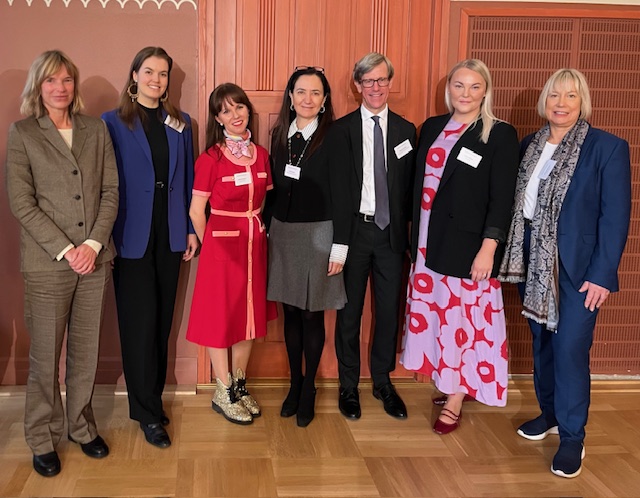
On Friday, 24 October 2025, the Helsinki IP Summit brought together leading fashion law experts and enthusiasts to share insights and discuss the most pressing legal issues in one of the world’s most glamorous yet exploitative sectors. This article summarises the key points of the session.
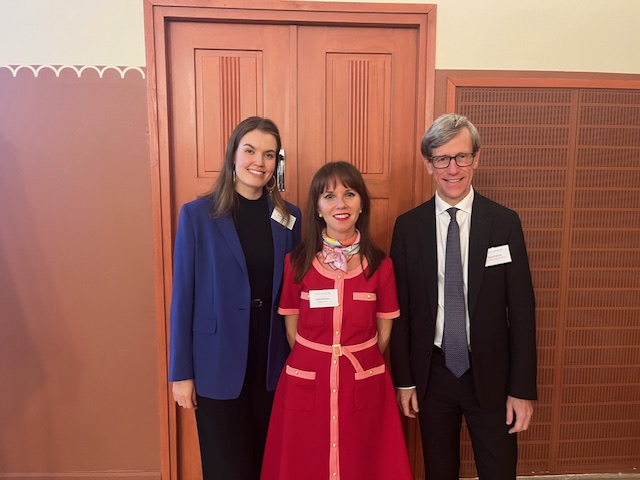
Last spring, fashion law legend and professor Irene Calboli, Auri Vainio, executive manager of the IPR University Centre, and I, adjunct professor of fashion law Heidi Härkönen, gathered to discuss the recently published Handbook of Fashion Law (Oxford University Press, 2025), edited by Calboli and Prof. Eleonora Rosati. Recognising that Finland has a vibrant fashion law scene, we knew that the Finnish audience would be eager to continue the discussions presented in this edited book’s 40+ chapters. Consequently, we decided to dedicate part of Finland’s most notable IP conference, the biannual Helsinki IP Summit, to fashion law.
Irene Calboli and the value we give to fashion
Heidi Härkönen chaired the session, welcoming Irene Calboli to deliver the keynote speech, ‘Re-stitching the Threads: Fashion at the Crossroads of Tradition, Innovation, and Sustainability’. Referring to her numerous publications on IP and sustainability, Calboli once again drew attention to the value of fashion in society. In the era of fast fashion, it is easy to forget that fashion essentially involves crafts and requires artisan skills. People no longer learn the skills needed to make garments, and the ability to create them is reserved for those with passion and the willingness to spend hundreds or thousands of hours learning pattern-making, sewing, and tailoring. Calboli also reminded us of the social aspects of fashion, such as the people who work in various parts of the supply chain for this glamorous industry without getting recognition. These people include not only garment workers in the Global South, but also European creators who work around the clock for free, while their creations are attributed to their more established colleagues. Furthermore, we must be more circular: repair, reuse, upcycling and recycling must be encouraged by the legal system.
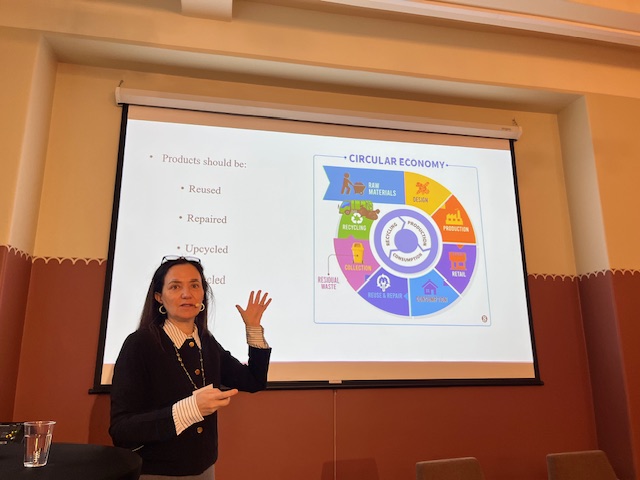
Calboli also shed light on the process of drafting The Handbook of Fashion Law. She rightly noted that there has been a need for an English-language, academic, peer-reviewed, comprehensive volume on fashion law for years – or even decades. (As someone who has researched fashion law since 2013, I completely agree!) While we have plenty of practical handbooks, a volume like this did not exist before the work of Calboli and Rosati.
According to Irene Calboli, fashion law is unlike traditional IP law sectors (e.g. trademark law). It is a hybrid of many different legal disciplines that overlap with the fashion and textiles industry. Fashion as a phenomenon has various ’legal layers’.
IP and cultural heritage – Lord Justice Arnold
Our next speaker was Lord Justice Richard Arnold from the Court of Appeal of England and Wales, whom we had the pleasure of welcoming. He shared his insights on intellectual property (IP) and cultural heritage, a classic topic in fashion law, and focused on the copyright aspects of this vast subject. He emphasised the importance of balance, discussing ways to balance IP law through internal versus external measures. In the latter case, fundamental rights are brought into the IP discussion. Lord Justice Arnold noted that a balanced copyright system can and should promote both the preservation of and access to cultural heritage.
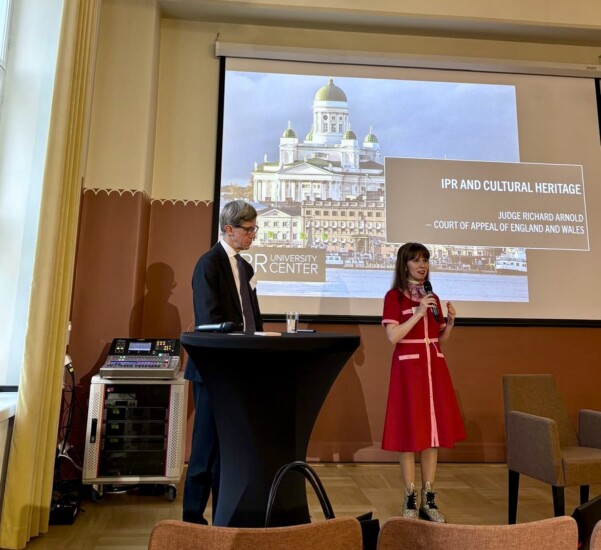
He connected this theme to the EU standard of originality and emphasised that the requirement for copyright protection for all types of work is ’the author’s own intellectual creation’ (C-5/08 Infopaq), with no other criteria. You might think that this is obvious, and that national traditions diverging from this criterion would have been eliminated long ago. However, this is not the case. Lord Justice Arnold referred to Estelle Derclaye’s research showing how reluctant national courts are to abandon national traditions. Indeed, there is a high level of non-compliance. (Coincidentally, the presentation Mikko Antikainen and I gave earlier at the same conference tells a similar story about Finland.)
Lord Justice Arnold also discussed an interesting issue: the scope of copyright protection and its relation to the level of originality. This is a disputed theme at the moment, but he firmly believes that the level of originality corresponds with the scope of protection. The scope of protection relates to the preservation and accessibility of cultural heritage, particularly in light of the C-145/10 Painer ruling. One might think that this judgement means that the scope of protection is not affected by the level of originality; however, the court essentially says that ’just because it is a portrait photograph does not mean it gets less protection’. The fact that a photograph is a portrait does not mean that it cannot fulfil the ’author’s own intellectual creation’ standard – and that is a different point.
Museums and galleries tend to claim copyright for the digitisation of photos and paintings in their collections. In light of Painer, and following the above analysis, it could be argued that the scope of protection for such digitalisation would be very narrow. Lord Justice Arnold pointed out that the trend towards the commodification of data is dangerous because information cannot be owned. Sticking to this rule avoids plenty of problems, concluded Lord Justice Arnold. I started thinking that this conclusion could easily be applied to fashion trends — as long as we remember the ’idea vs. expression’ dichotomy and view trends as ideas, we allow different designers to contribute to the same trends and prevent styles from being monopolised. This also fosters freedom of expression in fashion creation, which brings us back to the question of external balancing in copyright law.
Liability in fashion IP claims – could an unfounded IP claim in the media mean criminal or civil law liability?
After hearing inspiring speeches from an academic and a judge, we moved on to practical matters and gave the stage to Emilia Hodge (Berggren), who could be characterized as ‘The Finnish fashion lawyer’. A well-known name in the Finnish IP/fashion law scene, Hodge is also the co-author of Muotioikeus (Edita Lakitieto, 2024), the first Finnish textbook on fashion law. Hodge touched upon an important yet rarely researched topic: can an unfounded IP claim result in criminal or civil liability?
We all know that the fashion world loves its ’plagiarism scandals’. Designers and the general public alike are always up for a nice media scandal! (See previous IPRinfo articles here and here (in Finnish)). To us lawyers, many of these scandals seem unfounded, and they rarely lead to legal proceedings, let alone judgements. Yet accusations of ’plagiarism’ continue to emerge. It almost seems as if some designers use these accusations as a kind of ’trial by media’. The public really tends to confuse IP infringement with other issues.
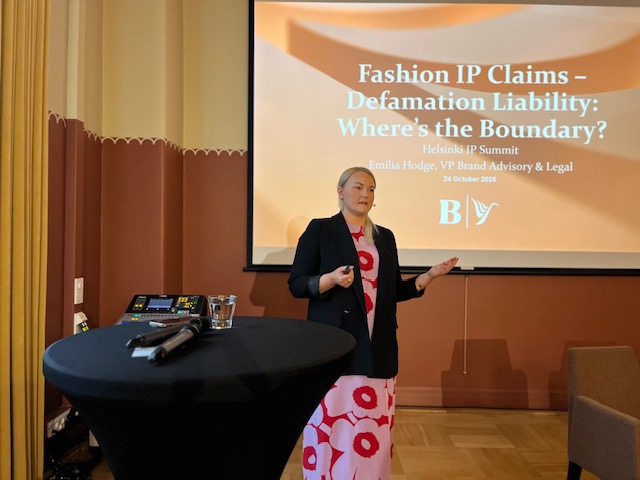
According to the Finnish Penal Code (39/1889), legal persons (e.g. companies) cannot be victims of defamation. In other words, accusing a company of plagiarism does not constitute defamation. However, an interesting feature of these scandals is that the names of the accused designers are often mentioned, or can easily be guessed – and they can claim defamation. Hodge provided fascinating insights into liability in these cases from both criminal and civil law perspectives. She also mentioned the potential consequences for a designer who is falsely accused of plagiarism, such as loss of income, loss of job, termination of an agreement and decreased sales. The negative consequences for individuals have so far received very little attention. Hodge, of course, noted that the aim is not to silence public discussion or freedom of speech; fundamental rights must be taken into consideration. However, the media in particular should pay attention to how they report on these plagiarism claims. Hodge mentioned that she is currently researching this topic and hopes to publish more on it. We are looking forward to reading her work on this fascinating and novel topic!
Fashion upcycling and copyright infringement: perspectives from the academia and design education
With upcycling set to become the next major area of conflict between IP rightsholders and users, it was essential to include this topic in the fashion law session at IP Summit. Furthermore, it was simply not an option not to invite Maria Rehbinder (Senior Legal Counsel at Aalto University) to talk about upcycling. Rehbinder has gained fame as some kind of a ‘copyright activist’ by issuing a sustainability-minded dissenting opinion on the infamous Finnish Copyright Council statement (TN 2021:9 Tableware Jewellery), in which the majority argued that the rule of exhaustion did not apply to jewellery made by an artisan from broken cups and plates. You can read more about the case here. To facilitate a dialogue on upcycling, we invited Professor Taina Pihlajarinne from the University of Helsinki to join the discussion. Pihlajarinne is renowned for her pioneering research into the conflicts between IP protection and sustainable development.
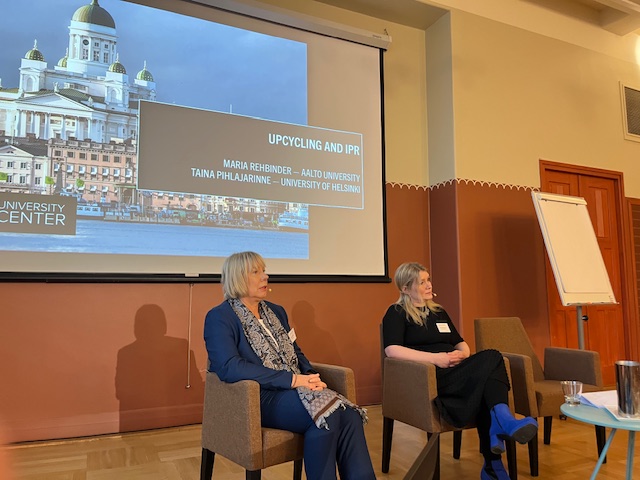
Pihlajarinne recently developed a sustainability-oriented model for assessing copyright infringement. She presented this model to us and mentioned that the research behind it will be published in The Cambridge Handbook of Intellectual Property and Upcycling next year, edited by Péter Mezei and me, Heidi Härkönen. Pihlajarinne argues that only actions which go beyond the genuine purpose of maximising product lifespan should be considered infringements, and suggests embedding material lifespan considerations into IPRs.
She also drew attention to the power imbalance between upcyclists and rightsholders who object to the upcycling of their products. Upcyclists are often micro-enterprises, SMEs, or artisans and lack the resources to defend themselves against large corporations.
Maria Rehbinder’s work at Aalto University is centred around sustainability. Aalto University’s mission is also to promote sustainable development, educating future designers, artists, engineers and economists. This is evident in many of Aalto’s research projects, such as Trash-2-cash, Finix and T-Rex. Students at the Aalto School of Art and Design are extremely interested in upcycling and are dedicated to shaping the future of fashion in a sustainable manner, which is why Rehbinder often needs to provide guidance in interpreting IP laws from the perspective of upcycling.
For Rehbinder, environmental values are of the utmost importance. Like Pihlajarinne, she argued that it is entirely feasible to consider sustainability when assessing copyright infringement. In the Copyright Council case TN 2021:9 Tableware jewellery, for example, the internal balancing mechanism, or principle of exhaustion, in the Finnish Copyright Act (404/1961), would have been sufficient to achieve a sustainable outcome. However, the majority of the Copyright Council was reluctant to do so. As Rehbinder has already mentioned, she simply cannot endorse such disproportionate interpretations of the law.
Fashion law case examples
Next, we examined both international and European case law concerning fashion products. Markku Tuominen, an attorney-at-law at Roschier, and Stina Teilmann-Lock, an associate professor at Copenhagen Business School, presented insights from the US, China and Denmark.
Markku Tuominen offered a comparative perspective on copyright protection for fashion in the US, the People’s Republic of China and the European Union. He argued that the threshold of protection in Europe is lower than in the US and China. Interestingly, Chinese courts appear to apply a kind of average observer test, which is not recognised in EU copyright law and is more relevant to design law. Furthermore, China requires artistic merit for works to be protected – a concept foreign to EU copyright law, as we learned from the C-683/17 Cofemel judgement. China also appears to apply a form of conceptual separation test, bearing resemblance to the requirements in US copyright law for works of applied art.
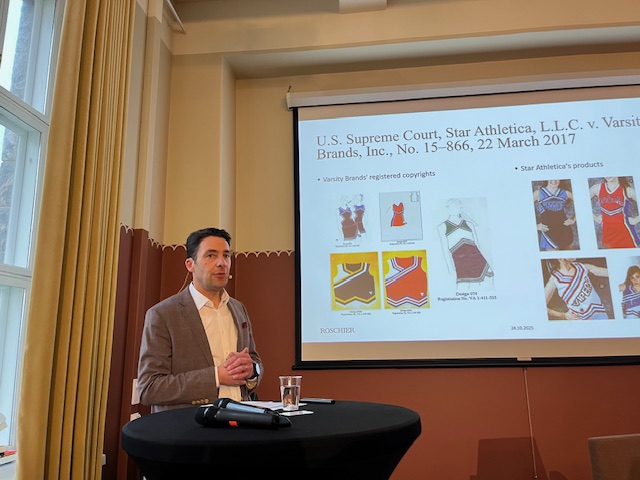
Tuominen appreciates the ability to register copyright in America and China, as it is a helpful tool for proving ownership and sending cease-and-desist letters. However, this system is sometimes misused, and fraudulent registrations are not unheard of.
Overall, Tuominen believes that the Chinese copyright system has developed significantly in recent years. For example, compensation for damages can now be substantial.
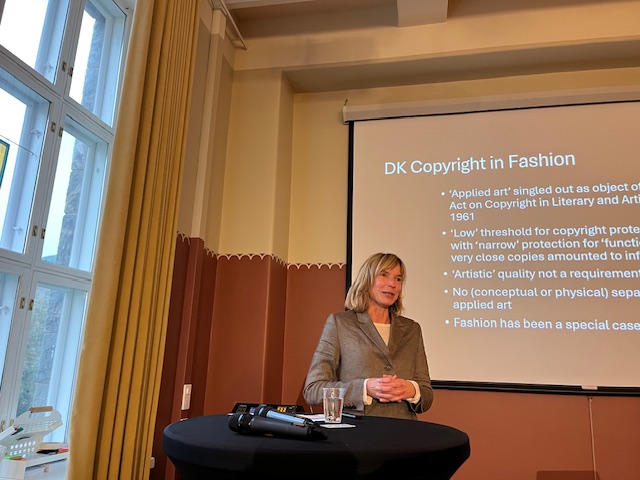
Stina Teilmann-Lock gave us a brief and fascinating introduction to the perspective of the Danish copyright tradition on applied art, before delving into one of the most interesting recent Danish fashion law judgements: the Ganni buckle ballerina case. Teilmann-Lock noted that, unlike in Finland, there is plenty of design litigation in Denmark. The traditional Danish approach to applied art has been to have a low threshold and narrow protection. There has never been an artistic merit requirement.
Although some Danish judgements this century have ruled that fashion products are not copyright protected, this is no longer the case – at least with regard to the Ganni buckle ballerinas, which were a ‘must-have’ a few summers ago. Ganni produced these shoes in several slightly different models. As usual, other brands wanted a piece of the action, which led to litigation.
In March 2025, a higher court in Denmark ruled that the distinctive features of the Ganni buckle ballerina were combined in such a novel and creative manner that the shoe was deemed to be an expression of the designer’s intellectual creativity. Teilmann-Lock noted that this changed the landscape for copyright protection of fashion in Denmark.
She also noted that Danish case law clearly distinguishes between idea and expression – and when it comes to fashion, the idea and expression, or trend versus an individual product reflecting a trend, are sometimes confused. Teilmann-Lock also observed that ’novelty’ is becoming a substitute for ’free and creative’ in copyright terminology, even though novelty itself is not relevant to copyright analysis.
Cultural heritage and entertainment: the case of Frozen II
The last speaker of the fashion session was Pauliina Rajala / Oahptii-Hánssa Airi Minna Pauliina, IPR University Center, who gave us fascinating insights into the indigenous Sámi cultural heritage and its use in the entertainment sector. She began by noting that it is fair to say – and I wholeheartedly agree – that the Sámi cultural heritage has been appropriated by the tourism industry, the media, the fashion sector, and beauty pageants, among others. However, cultural influences are sometimes shared more fairly, as in the case of the Disney animation Frozen II. This film was actually produced in collaboration with the Sámi people. Sámi culture is evident in the film through the music, costumes, and storytelling. The fictional group Northuldra is inspired by the Sámi people. Some of the Sámi-inspired elements in the film are more obvious to Sámi people and those familiar with Sámi culture, while others can be easily discovered by the general public. For instance, almost anyone can see that Kristoff’s outfit is inspired by the traditional Sámi garment, the gákti. However, the reference in Anna’s scarf might not be as obvious to an outsider. This scarf, which belonged to Anna’s mother, immediately revealed her mother’s identity to the Northuldra people. This also references the Sámi culture, where a person can learn a lot about another person based on the details of their gákti.
Rajala views Frozen II as a successful example of culturally sensitive entertainment production. She notes that cultural heritage is a sensitive issue and that it is important to obtain informed consent from the relevant cultural group before incorporating their cultural elements into any new creation or production. In conclusion, she mentioned that Frozen II has had a positive impact on the image of the Sámi people, and that Disney has probably learned something from the collaboration as well.
Concluding remarks
Finland is a small country and, let’s face it, we’re not renowned for our fashion scene, brands or sense of style — especially compared to other Nordic countries like Denmark and Sweden. Against this backdrop, the vibrancy of our fashion law scene is rather surprising! This is undoubtedly thanks to the many Finnish fashion law enthusiasts and the active Finnish Fashion Law Association, which now has over 160 members. It was encouraging to see that the topics of this Helsinki IP Summit parallel session attracted both national and international IP experts, who came together to listen to and discuss current fashion law issues from a variety of perspectives. However, one perspective was completely absent: the old-fashioned notion (sometimes espoused by conservative legal scholars) that fashion law is superficial and vain, and a superfluous addition to the legal discipline. I believe this prejudice was disproven a long time ago.