

How to build a successful IP legal team and ensure a seamless integration of IP in the business operations of your company

At the IP Academy held in November 2024, students had the opportunity to attend for free with the support of the IPR University Center Association and earn credits by writing articles about the event. We selected one article for publication and are pleased to introduce Karoliina Becker from the University of Turku.
 Could you briefly tell us about yourself?
I am studying law at the University of Turku, and I am currently in the final stages of my Master’s degree. Attending IP Academy in November was a great opportunity not only to learn a lot of new things, but also to get a welcome break from my thesis-filled everyday life! Besides law, I have always been passionate about learning languages, travelling and getting to know different cultures. This interest has led me, alongside my law studies, for example, to do a student exchange in South Korea and a language course in Germany.
What motives you in the IP field?
I became interested in IP because of its diversity, international character and constant development. I find legal issues related to creative work and technology in particular really interesting! Recently, it has also been exciting to see how IP issues are affected by the rapid development of artificial intelligence. I am also motivated by the fact that IP is of great importance for both individual creators and companies, which gives me the opportunity to work on a very broad range of legal issues related to creative work and innovation.
What kind of a career are you working towards?
At this early stage of my career, I think it would be great to have a wide range of experience in IP, both in law firms and in the corporate world! Particularly towards the end of my studies, I have also discovered, what is interesting in employment law and business law more broadly. At the moment, I could see myself working in the future in an international environment with some of these topics! Fortunately, due to the continuous development of the sector, there will be plenty of challenges and a multitude of new things to learn about in the future.
How to build a successful IP legal team and ensure a seamless integration of IP in the business operations of your company
IP Academy, which was held at the end of November 2024, was a two-day seminar that brought together top industry experts to share ideas on integrating Intellectual Property (IP) into companies’ business operations. Organized as a joint effort by IPR University Center and Roberto Castagno, Head of IPR at Neste Oyj, the seminar included various interesting speeches and discussions on topics such as the Future of IP Management, Career in IP, building a strong IP legal team and IP as a part of the company’s business strategy.
As we are living in an age of rapid technological innovation and digitalization, IP has become crucial for any business. However, to manage IP successfully as a key part of the company’s business, it is essential to know how to build a team that can effectively support your business goals and ensure that your IP asset’s potential is realized. This was also the main question of this year’s seminar, which is why in this text I have summarized some key takeaways from a student’s perspective on the topics discussed over the two days.
Integrated Intellectual Property
When asked, how IP should be defined, oftentimes the answer consists of the following list: patents, trademarks, industrial designs, copyright, trade secrets etc. Although not technically incorrect, the more important perspective to take is to ask what IP can enable, as part of a company’s business strategy? Bowman Heiden highlighted the importance of this question in his keynote speech ”Is your IP Strategy Strategic?”. Simply put, IP can be defined as technology and the means to control it in a way that creates value or competitive advantage for a company.
IP rights play a key role in protecting innovative ideas and creations of companies, preventing others from exploiting their innovative efforts, and therefore serving as valuable assets that can be, for example sold or licensed to others. IP can be seen as a key driver in providing companies with a competitive advantage in the market. It is a crucial part of creating a reputation that distinguishes their products from those of competitors.[i]
However, the problem often seems to be a gap between the technological side and the business strategy side of a company. Heiden pointed out that typically within a company, the IP team is a separate small unit that focuses mainly on the technology and operations side, while the business and strategy side of the company operates as a separate entity. There is often a lack of communication between these parts of the company, as IP experts are usually primarily focused on specific IPR activities such as patent prosecution, and business leaders in turn have little IP knowledge. It is the combination of business and IP expertise that is one of the most important elements of integrating IP successfully into the business operations of a company.
The importance of communication between the different roles within a company is a vital part in succeeding in the above. Interestingly, the panel also discussed the importance of the language used, when bringing up IP topics in a boardroom. It is important to consider how the company’s IP issues are presented to the board, rather it is essential that the importance and value of IP are communicated effectively to those responsible for making key business decisions that affect the company’s growth.
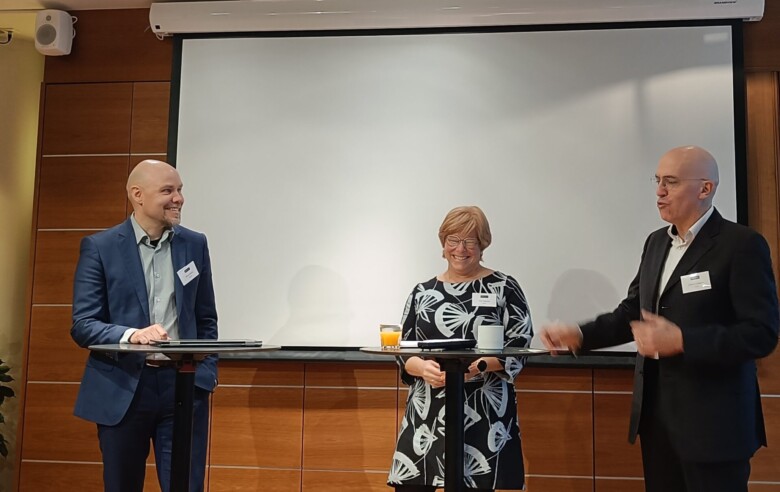 Does this job of enabling communication fall under the role of ”the Head of IP”? A panel with Roberto Castagno, Virpi Tognetty (Director, IP Management, Kemira) and Mikael Mäkela (Director, Intellectual Asset Management, Wärtsilä) touched on this topic in their discussion about the ”Joys and sorrows of the ”Head of IP”. The message was that the IP department must ensure it provides the company with the technological tools it needs to run its business. Even if the business side of the company makes the final decisions, the IPR department should have an opinion or solution to present on which the decisions can be based on. Thus, the IP team leadership must understand not just the IP technical issues, but also the business objectives of the company.
Building blocks of an IP Team
But what is a Head of IP without their team? Solution-oriented, positive, curious and diverse are some of the qualities that emerged in a panel discussion concerning creating successful IP legal teams. As stated above, the combination of business and IP knowledge has been identified as a key enabler for success. Therefore, having diversity within the IP team was also seen as a beneficial feature.
For creating a successful IP team, the foundation seems to lie in its composition. When I searched in LinkedIn for tips on building a top IP team, the answer remained the same regardless of where I looked; a diverse team with employees possessing different skills and backgrounds ensures a well-rounded team, fit to take on the multifaceted challenges of IP.[ii] The panel also delved deeper into the qualities they look for in the people they would hire for a team. A great team member is active, curious and trustworthy but also comfortable operating in an environment where many of the relevant questions are yet to be answered.
An IP Legal team should be an enabling and solution-oriented part of the company, rather than only focusing on the more traditional view of informing the rest of the company of what ”cannot be done”. The aim of a great team is to demystify IP and find answers and solutions to unanswered questions. This is not always an easy task. Therefore, a great quality in a team member is strong resilience, as you ”might have to get used to the fact that you don’t always get what you want”.
As a student I also found some of the advice given to those at the beginning of their careers extremely intriguing. The main lessons learned were that it is helpful to be open-minded, open to opportunities and not be scared of trying out different things. Drawing from the conclusions above, a broader understanding of the business operations of a company or previous experience in that field certainly cannot be harmful.
Artificial intelligence for a successful IP professional
I summarized the ideas raised at this year’s IP Academy on how to successfully integrate IP into a company’s business as well as the key points on how to build a strong and successful IP team to achieve this goal. To conclude, I highlight a very interesting point from Sonja London’s keynote speech ”Future of IP Management and Deal-Making, which started the two-day event. London touched on some of the current megatrends and future innovations in the field of IP and out of those highlighted artificial intelligence (Al). What struck me was her message: ”start using Al or fall behind”.
Therefore, I decided to ask Chat GPT these same questions, which I have discussed in this text. With the help of Al, here is a little recap of how to successfully integrate IP in the business operations of a company:
- Identify your IP Assets: a good starting point is to audit the company’s existing IP assets and classify them based on their type and use (for example branding, inventions, trade secrets )
- Protect Your IP: a more technical side of IP, but still essential advice from Chat GPT; register trademarks and patents, monitor for potential infringements and register IP in key markets to protect your rights globally.
- Integrate IP into Business Strategy: Chat GPT also highlights the importance of leveraging IP for competitive advantage and value creation, which based on the seminar was arguably seen as the most important point
Along with three tips to successfully build an IP legal team:
- Hire a Diverse and Specialized Team: Chat GPT recommends including attorneys, as well as IP specialists and IP strategists from different backgrounds.
- Integrate with Business and R&D Teams: an effective team collaborates closely with other departments within the company
- Leverage Technology and Resources: Stay ahead of the game by investing in the newest technology and utilize analytic tools to monitor your IP portfolio.
Based on the knowledge from this year’s IP Academy, I was quite impressed by the answers given by Chat GPT. Al successfully summed up all essential points. However, there is one crucial part missing, when turning to Al for help in situations like this. In my opinion, it lacks the most important part of seminars: communication. The opportunity to meet people, sit in the same room with different experts and share experiences and wisdom with each other, is something Al cannot replace.
_______________
[i] UNtoday, ”The power of intellectual property”, 2024.
[ii] 5 Tips for Building a High-Performing IP Team, Linkedln.
____________________________
Kannen kuva: iStock/Paperkites
Kuva 1: Karoliina Becker
Kuva 2: IP Academy
Kirjoittajat