

Effective IP Strategy through Dr. Bowman Heiden’s eyes

At IP Academy last autumn we had the opportunity to hear from Dr. Bowman Heiden on the topic “Is your IP Strategy, Strategic?” In this presentation he enlightened us on how to manage IP in a more strategic way by combining technology, business focus and IP. From Dr. Heiden’s value-oriented perspective, we should strive for effectiveness rather than efficiency. Heiden was also kind enough to give us an interview in which he explained his way of thinking about the world and IP strategy in particular.
– I think the thing that has governed almost everything I’ve done is I’m very curious, right? Dr Heiden says.

This curiosity drives Dr. Heiden to learn and try new things. As he explains, when he had the opportunity to play basketball in Europe, it wasn’t just play basketball but instead it was an opportunity to experience something new. Following his curiosity Dr. Heiden has achieved the role of the Director of the Center for Intellectual Property (CIP) at the University of Gothenburg. He is also the Executive Director of the Tusher Strategic Initiative for Technology Leadership at UC-Berkeley and co-founded the Berkeley Deep Tech Innovation Lab, the Dynamic Competition Initiative, ICM Global and Increasing Diversity in Innovation. He also co-chairs the Technology, Innovation, and Intellectual Property program at the Classical Liberal Institute at the NYU School of Law. With this extensive list of titles, Dr. Heiden has established himself as a distinguished professional.
-As my wife says, I’m a bad tourist. I like to live in a place and see what it’s really like. This is why I’ve ended up living in about 10 different countries and I have spent a substantial time doing different things. All this experience moving around, living in different countries with different cultures, different ways of doing things, opens you up to see that there’s lots of trails up the mountain to the top.
And this is what Dr. Heiden has done. In addition to the above accolades Dr. Heiden has led over 150 innovative projects and he has been part of the European Commission Expert Group on Standard Essential Patents.
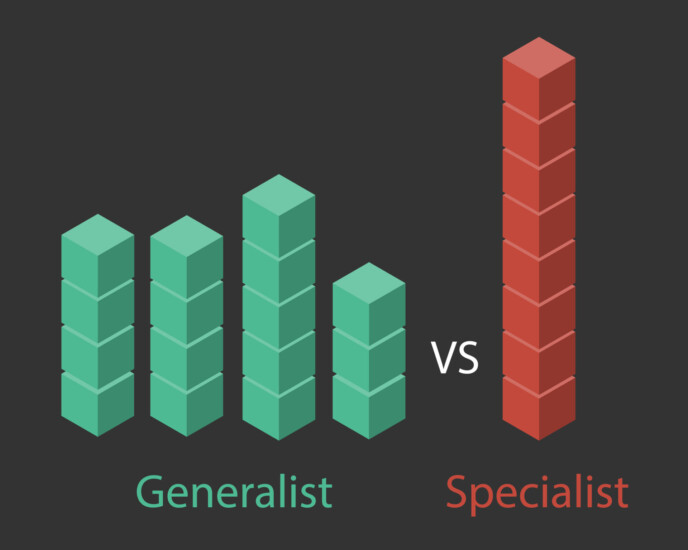
Generalist-specialist-dichotomy
At IP Academy, Dr. Heiden spoke about how our world needs leaders who understand business, technology and intellectual property.
-Part of the problem we have is that the world tries to turn everyone into a specialist. Whitening the tip of the pin as I said.
With the phrase “whitening the tip of the pin”, Dr. Heiden compares the work of a specialist to the process of manufacturing pins in several steps. In this process, each person specialises in one step to increase efficiency. As a result, each person who specialises in a production step or area of expertise loses sight of the big picture and the reason for their work.
-When you do a lot of different things, it’s tricky because you keep moving into new areas. Every time it becomes more difficult because there’s people that are experts in that field. In the short term it takes effort because you feel a little behind everyone else but if you’re competitive being behind is good because it gives you a goal! Dr. Heiden explains.
Dr. Heiden has certainly experienced the challenge of moving into a new area having studied engineering, technology management, and economics. The diversity of his background is evident in his research, which combines economics, law and innovation. However, he sees it as a blessing and recommends young professionals in the field to also be bold and experience different things.
-At some point in time when you’re old like me, it all kind of comes together and you see all the interconnections. Now I see things very clearly in ways that are difficult for people that are very, you know, “I” shaped.
At IP Academy, Dr. Heiden explained the concept of T-shaped and I-shaped people. According to Dr. Heiden, T-shaped people are interdisciplinary experts, such as lawyers or engineers, who are not only experts in their own field, but also understand other fields and the wider consequences of their actions. When it comes to IP, especially in technology-based companies, Dr. Heiden says IP professionals, need to have knowledge of technology, economics, and IP law. They must cover all these areas to be effective professionals and leaders. On the contrary I-shaped people focus only on their own field and lack interdisciplinary thinking.
Dr. Heiden explains that over time the “T-shape” becomes deeper, which means that your understanding becomes deeper and broader. All of this, says Dr. Heiden, helps a person to see the big picture. He recommends adopting an entrepreneurial mindset: try, fail and try again until you find the right thing to do. Only when you have found the right thing to do, make that thing efficient.
-I’m very much an effectiveness over efficiency person. Doing the right thing is worth a hundred times doing the semi right thing or wrong thing very well, Dr. Heiden summarizes.
However, he also points out that not everyone wants to be or even needs to be everything.
– There’s this idea going around that everybody should be innovative and entrepreneurial. I however, always joke that “have you met people?” Not everybody wants to see change all the time. In fact, it’s very few people that are comfortable putting themselves out there and leaving a safe environment for a more uncertain one. I try to support those people because they are a little crazy, but we need them to move things forward, He says with a twinkle in his eyes.
Interdisciplinary thinking and standard essential patents
Dr. Heiden’s believes it is important to look at the bigger picture. As an example, he mentions the discussion about standard essential patents. He argues that we shouldn’t see litigation over SEPs related to mobile phones and connectivity as a problem, since the result is that nearly everyone in the world has a mobile phone. In his view, if the result of active litigation was that mobile phones were reserved for a limited group, litigation would clearly be an issue.
Dr. Heiden goes on to point out the difficulties of group work and the desire of each actor to maximize its own benefits by “tweaking the details”. However, he emphasises that we should think carefully when solving remaining issues within the system so as to not destroy the effectiveness of the system.
-This issue is not about solving that problem, but understanding how society can work collaboratively to produce value, given the fact that all the actors working collaboratively also need to make money themselves. This is quite a complicated thing, right? The question is, how do we create a system where they make money in a way that benefits society? He asks and adds that it is his goal to look at these systems and to try to find ways in which this could be done.
Dr. Heiden emphasises that controlling knowledge is a prerequisite for sharing it. The question is how and for how long knowledge can be controlled and for how long. He provides an example from the pharmaceutical industry.
-With medicine, they may be expensive for a while but if they are not expensive there wouldn’t be any incentive to innovate. It is strange to convince people to understand how, by blocking people from getting something, we’re making it more accessible to humanity in the long run, Dr. Heiden concludes.
Effective business strategies
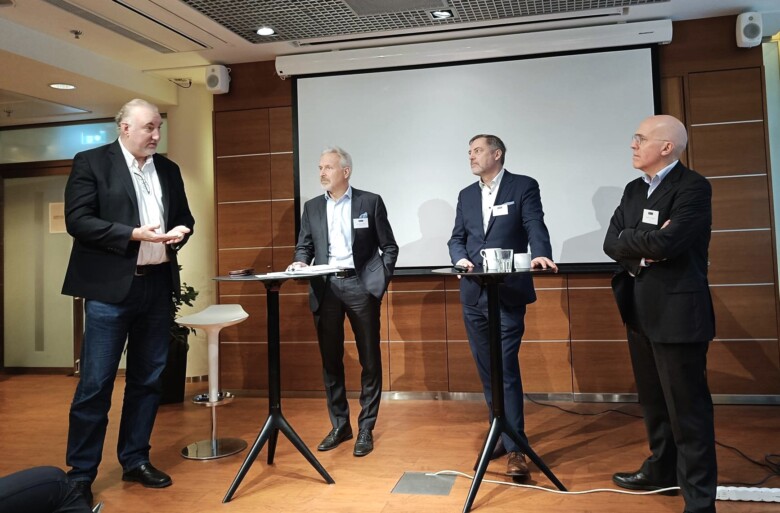
In his speech at IP Academy, Dr. Heiden asked the participants to define intellectual property. He himself defined it as something sitting at the intersection of business value, control and an intellectual resource. He basically defined it as a competitive advantage.
However, he lamented that IP is often separated from other areas within companies, or given a very limited role within R&D, which limits the possibilities of using it effectively and integrating it into business strategy. Typically, Dr. Heiden explains, IP is managed as an end in itself rather than as the tool it is.
In order to exploit IP, he recommends that we adopt a model of technology-based business management, where we combine business strategy, intellectual property and R&D. In essence, he says that IP Strategy should be business-driven.
At IP Academy, he asked operating companies, if they could prove that their patent portfolio was worth more than zero, and he asked service providers, if they could prove that they had created more value than costs for their clients. In this way, he argued that companies should not just focus on doing things effectively, but that they should be strategic about what they do. He argues that companies should view the IP department as something that creates value for the company and measure the success of the team by the profit it creates. Dr. Heiden however, adds that in his experience, both in the US and Europe, an IP expert should be able to better communicate the importance of what they do.
– How important do you expect to be, if you can’t tell people the value of what we [IP Profession] are? If you’re pitching your company to a venture capital to get funding and you’re like, well, I don’t really know if we’re going to make any money. Haven’t really looked into it. You’re not going to get the money, right?
But how do you bring this effective IP strategy mindset into an organisation? How do you get this knowledge to all levels from employees to partners?
Dr. Heiden explains that it requires a holistic approach within a company. Often solutions do not come through litigation but require other types of action. He reminds us that knowledge is the most valuable asset for a company, but that companies are often not designed that way.
-They [companies] are still designed in an industrial and hierarchical way. In these companies IP is just one of these departments even though IP is everywhere. And in the past, in the industrial world, IP and knowledge in general was something that you embedded into the physical product and then you sold the physical product, you didn’t sell the knowledge itself, right?
Nowadays, in a more digitised society, intangible assets such as data and software are the products themselves. In this context Dr. Heiden explains that when you sell knowledge itself, it is easy to distribute but difficult to control.
He explains that it is nowadays necessary for everyone in the company to understand the role of intangible assets in creating value for the company and the importance of controlling these assets to capture their value. In his view, whether they know it or not, everyone is involved in the control of knowledge. Of course, experts are also needed to carry out the detailed processes. Additionally, he reminds us that what this IP Strategic thinking may look like differs from company to company.
-For example, Uber and Tesla are worth a lot. But none of these came from the incumbent companies. The change came from new companies. The taxis didn’t come up with Uber. As another example, the automotive companies were very slow in doing electrification. Companies become a bit bureaucratic over time and it’s hard to transform them into something new.
What transforms us into something new? According to Dr. Heiden it often requires new people with new ideas. These people create new things, which will end up becoming bureaucratic themselves. However, he seems to advocate getting out of your comfort zone and being aware of your long-term strategy to achieve change.
-If you have money and you’re comfortable, you keep doing your thing. But if you don’t know exactly how this relates to the strategy of the firm, then is it really strategic?
Effective use of innovative resources
Dr. Heiden and his colleague Suzanne Harrison have a non-profit organisatin to increase diversity in innovation through which they aim to “capture lost innovations”. In relation to this non-profit. Dr. Heiden and Harrison worked on a paper on boosting competitiveness and Improving Diversity and Inclusivity. With our declining Finnish population, we desperately need Dr. Heiden’s expertise on what we need to do to boost our competitiveness.
Dr. Heiden and Harrison began their study by working with 50 companies to try to increase the amount of inventorship from underrepresented groups. Most companies, according to Dr. Heiden, started by trying to increase inventorship among women. He explains that one way to solve a resource problem is to become more productive and the other way is to have more people produce it at the same level. The aim of their project is to identify reasons why different groups are not participating and to get them to participate more. Dr. Heiden notes that when studying different groups, they often find issues that everyone is facing so they end up improving everyone’s situation, for example in the case of organisational challenges.
– It’s certainly this productivity perspective to try to get all these talented people you have in your company or society off the bench, right and into the game.
Of course, inclusivity is important, but he notes that there is also the opportunity to bring in more talented and entrepreneurial people to the country.
-I think it is in everybody’s interest to have the opportunity to self-actualize, but of course these issues are more institutionalized.
He notes that giving people the opportunity to self-actualize requires sincere effort and laments that the conversations surrounding these topics are often superficial. He also believes it is important to ensure the possibility of free choice. For example, he comments on our Nordic egalitarian societies by bringing up the differences between different groups in the type of fields they choose. He notes that people may choose fields in which they intuitively have a competitive advantage.
-It’s tricky to find out what you really want. Is it what you really want or is society pushing you into thinking that?
Where we are going
Throughout Dr. Heiden’s research and in his work, we see his interdisciplinary thinking that highlights effectiveness over efficiency. Dr. Heiden views the world through the lens of maximizing both profit and the benefit to society as a whole. His thoughts on strategy and leadership emphasize the need for both specialist knowledge and generalist wisdom. He respects an individual’s choice and expects us to build a world where people can self-actualize. In this way we can, in his opinion, make the best use of our innovative resources.
To be successful in the future, IP professionals and companies must have a holistic understanding of IP, business strategy and technology, especially taking in mind the current changing world. Dr. Heiden points out that the main trend in regards to IP in the 21st century has been a weakening of the IP system. He explains how, in today’s knowledge-based economy, there is a challenge in reconciling the interests of those who view IP as a cost and those who see it as a profit. He also points out that we shouldn’t forget that without IP we don’t have the incentive to create what we need.
-The idea of AI and new technologies altering the nature of how society functions make IP thinking obsolete. We’re always behind. When should we change the rules? How do we keep the incentive to innovate but make sure it benefits society? He asks.
______
IPR University Center is initiating an educational collaboration with CIP (Center for Intellectual Property) at the University of Gothenburg. CIP has been organizing a course for students on: Intellectual Capital Management: Strategic Innovation Management for the Knowledge Economy. The purpose of the program is to provide students with the interdisciplinary skills and tools necessary to create and manage strategies for innovation for the knowledge economy in general and the digital economy in particular. This course will be available for students of the member universities of IPR University Center.
________________
Article photo: iStock / Zoran Zeremski
Photos:
1 Bowman Heiden
3 Photo from IP Academy, Elaine Byman
Kirjoittajat