

Digital marketing of standard essential patent licensing programs

Buying a new smartphone or connecting your car to Wi-Fi feels effortless. But behind the scenes, every swipe, call, and streamed video depends on patent licensing agreements. These licenses grant companies the right to use patented technologies that are essential to standards (standard essential patents, SEPs), such as 4G, 5G, and Wi-Fi, and enable patent holders to receive returns on their R&D investments. SEP licensing is typically conducted on fair, reasonable, and non-discriminatory (FRAND) terms.
While these standardized technologies are everywhere, the business of licensing SEP is often hidden from public view. Negotiations occur behind closed doors, prices (royalty rates) are confidential, and newcomers entering the market may struggle to understand the rules of the game. Policymakers in Europe and beyond have debated new regulations (e.g., the European Commission’s recently withdrawn proposal for the Standard Essential Patents Regulation)[1] to make licensing more transparent; however, the details of business negotiations are typically never disclosed.
Licensing contracts are the result of often complex negotiations between patent holders (licensors) and companies that implement the patented technology into their products (licensees). Such negotiations can happen in two main ways. In bilateral licensing, a company negotiates directly with a patent holder. In contrast, patent pools bundle patents of multiple SEP holders and offer a single license—essentially a ‘one-stop shop’ for licensees. Because pools operate under the scrutiny of competition authorities, they tend to be more transparent, with more information available on the patent pool program websites, than individual patent holders (see Figure 1).
Patent holders and patent pool administrators use marketing tactics to sell their licenses. Our research (Özmen et al., 2025) is among the first to look at how patent pools and individual firms promote their licensing programs online.
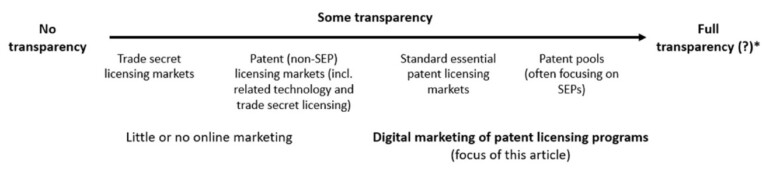
Figure 1 Transparency of patent licensing terms from an outside observer’s perspective
Source: Özmen et al. (2025). *There is no definition of “full” transparency in the context of patent licensing.
Lack of transparency in the SEP licensing market
In almost any commercial transaction and contracting, as well as in the SEP licensing market, one party is more informed (has an information advantage) about some aspects of the exchange (known as information asymmetry). Licensors hold much of the key information: the quality of their patent portfolio, the terms of past deals, and the scope of what their technology covers. On the other hand, licensees may remain silent about how much they could benefit from using that technology.
This informational imbalance creates uncertainty, friction, and slows down the licensing negotiation process. For big tech firms, it is just another round of negotiations. But for a small IoT startup entering the market, it can be very confusing.
Prospective licensees often have no way of knowing whether the rate they are offered is non-discriminatory or whether competitors are even paying the royalty sought by the licensor. This is particularly true for smaller firms and startups, which typically lack the resources and legal expertise to challenge the terms put in front of them.
Nevertheless, in recent years, there have been increasing efforts to provide guidance on SEP licensing and to promote greater transparency in the SEP licensing market.[2]
Our Findings: The Streaming Service Analogy
Our analysis of 48 SEP licensing programs’ websites revealed significant differences in transparency. Not surprisingly, patent pools revealed more information than individual licensors (c.f. Figure 1). Some even publish menus of options — different subscription models, annual caps, or discounts — almost like a streaming service plan (e.g., Netflix, Amazon Prime Video, Spotify, YouTube or Disney+) for patent licensing.
Patent pools are like the standard streaming service plan: the price and what you get are clearly shown upfront. They list the “catalog” of patents, often even their “subscribers” (licensees), and issue press releases much like a streaming service advertises new shows. Individual licensors, on the other hand, are more like “an exclusive” streaming service where you cannot see the subscription price or full catalog until you reach out privately. Less than half disclosed their royalty schemes, and only a handful revealed what patents or licensees were included.
Just as streaming service platforms offer different plans—basic, standard, premium—we found licensing programs experimenting with different pricing models. Most relied on a fixed per-unit fee (the equivalent of paying per view), but some used percentage-of-sales (ad valorem) models, and a few even tried subscription-style deals tied to end-user services. Like a streaming service’s family plan or student discount, some pools added marketing strategy elements such as price caps, discounts, or even logos that licensees could display on their products.
Finally, the “screen” that gets licensed is almost always the end-user device—your smartphone, your car—rather than the behind-the-scenes components, just like a streaming service charges you for watching on the TV, not for each chip inside it.
Navigating the SEP Market: Why Licensing Experience Matters
For experienced licensing parties (e.g., Nokia, Qualcomm, or Ericsson, see Galetovic et al., 2018) licensing is a well-practiced routine. They know the rules, the players, and the usual deal structures. But for a new entrant — say, a small company building smart sensors or connected vehicles — the lack of transparency can be a real barrier.
If AI tools can explain the basics and highlight available options, they could help level the playing field. But that only works if companies provide enough accurate and accessible information online. Without it, newcomers risk relying on incomplete or biased AI answers, which could distort their understanding and make negotiations even harder. Garbage in garbage out applies also here.
Transparency is the backbone of a functional SEP and FRAND licensing ecosystem. It helps to ensure that negotiations are fair, reduces the risk of costly disputes, and reassures all sides — from licensors and licensees to the end consumers who rely on standardized technologies.
This is not just about business efficiency. It is about innovation. The easier it is for new firms to navigate licensing, the faster new ideas and products can reach the market — whether that is in healthcare devices, green energy, or mobility solutions. Transparency, supported by responsible use of AI, becomes a catalyst for economic growth and technological progress.
Future of SEP licensing program websites: implications of GenAI tools
AI is already being used to analyze massive datasets, such as prior art searches or patent landscapes (e.g., Aristodemou & Tietze 2018, Bui 2025). But the real disruption may come from generative AI tools (e.g., OpenAI’s ChatGPT, Microsoft’s CoPilot, Google’s Gemini, or Anthropic’s Claude) and chatbots. Imagine a startup entering the Internet of Things (IoT) market. Instead of hiring a team of lawyers right away, the founders could type their questions into an AI assistant trained in licensing information. The chatbot might explain what a “per-unit royalty” means, summarize comparable deals, or point them to relevant licensing programs. In short, AI could act as a digital guide, lowering the barriers for newcomers and making negotiations less intimidating.
Yet there is a catch. These AI systems can only learn from what is publicly available. If companies strategically reveal only fragments of information on their websites, then the AI will reproduce a distorted picture of the licensing market. Worse, firms might even shape what AI “knows” by carefully curating the information they release — making their licensing offers look more or less attractive than they really are.
AI has the potential to reduce information asymmetry and improve transparency, but it could also entrench existing biases and make the “black box” of licensing even harder to open. There are both opportunities and risks.
Will AI Enhance Transparency—or Reinforce Secrecy?
Tomorrow’s trust in licensing may depend on today’s transparency.
Today, patent pools are leading the way in digital transparency, while many individual licensors still choose to keep the information behind closed doors. Tomorrow, AI could transform how companies understand and access licensing — but only if the underlying information is trustworthy and openly available.
The stakes are high: if transparency improves, AI could help build trust, reduce costs, and accelerate innovation. But if information stays hidden, AI might only deepen the mystery.
The choice is in the hands of SEP licensing ecosystem players and policymakers: Will AI open the black box of licensing, or simply lock it tighter?
(This article is based on the publication: Özmen, G., Heikkilä, J., Karvonen, M., & Ojanen, V. (2025). Digital marketing of standard essential patent licensing programs. World Patent Information, 82, 102385. https://doi.org/10.1016/j.wpi.2025.102385)
References
Aristodemou, L. & Tietze, F. (2018). The state-of-the-art on intellectual property analytics (IPA): a literature review on artificial intelligence, machine learning and deep learning methods for analysing intellectual property (IP) data. World Patent Information 75, 37-51.
Bui. L. (2025). Advancing patent law with generative AI: Human-in-the-loop systems for AI-assisted drafting, prior art search, and multimodal IP protection. World Patent Information 80, 102341.
Galetovic, A., Haber, S. & Zaretzki, L. (2018). An estimate of the average cumulative royalty yield in the world mobile phone industry: theory, measurement, and results. Telecommunications Policy 42(3), 263–276. https://doi.org/10.1016/j.telpol.2018.02.002
[1] https://ec.europa.eu/newsroom/eismea/items/871191/en
[2] See UK IPO’s guidance on SEP licensing: https://www.gov.uk/guidance/standard-essential-patent-licensing, WIPO’s information on SEPs, https://www.wipo.int/en/web/patents/topics/sep and EPO: “Technology standards and patents for Europe’s digital future”, https://www.epo.org/en/news-events/news/technology-standards-and-patents-europes-digital-future
Kannen kuva: iStock / Pornpimone Audkamkong
Kirjoittajat